


Creativity Isn’t a Gift. It’s a Dare.
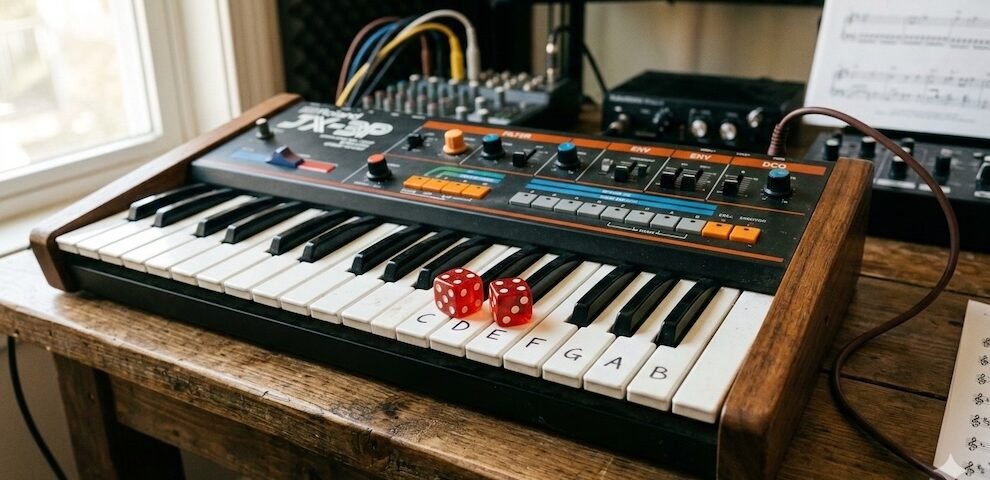
Your musical limitations are your greatest advantage.
The inspiration for this post has come from one of my favourite youtubers – Guy Michelmore and his video “How to be Creative”, at exactly the time, when I was thinking what would be the best way to continue in my Musicably idea. Over the past four posts, we have been diagnosing a quiet epidemic. We gave it a name – Musical Malnutrition – and we traced its causes: a world that casts us as passive consumers of sound rather than active makers of it. We borrowed a verb from musicologist Christopher Small: musicking. Not music as a noun. Not a thing to be owned or streamed or admired from a distance. Music as something you do.
We climbed the Musicking Pyramid together – from Presence, to Listening, to something that stops most people in their tracks.
We arrived at the top: Improvisation. Creation.
And here, the inner voice kicks in. You know the one.
“I’m not creative.” “I’m not musical.” “That’s for other people.”
Today, we dismantle that voice. Not by arguing with it – but by showing you that the very condition you think disqualifies you from creativity is, in fact, your greatest creative advantage.
The Myth of the Pink Powder Puff
There is a fantasy version of creativity that our culture loves to sell. In this version, inspiration descends from somewhere above – a divine spark, a bolt of genius, a mysterious “gift” – and lands, seemingly at random, on chosen individuals. Composers. Artists. Visionaries.
Everyone else is left watching.
Award-winning musician and author David Usher calls this out bluntly in his book Let the Elephants Run: creativity is not a gift distributed to a lucky few. It is in everyone’s DNA. Watch any group of four-year-olds and the evidence is overwhelming — every child draws, invents stories, bangs rhythmically on anything within reach, sings without shame. Nobody asks for permission. Nobody worries whether it is good. Music is birthright, not a talent.
The malnutrition begins not at birth, but later. It sets in when we start believing the myth.
Composer and educator Guy Michelmore puts it plainly: “To be creative is to be human.” Not to be talented. Not to be trained. To be human. Which means the question was never whether you are creative. The question is only whether you are practicing it.
The Engine (And What It Actually Means for You)
If creativity is not a gift but a practice, then it helps to understand how the practice works. Michelmore breaks it down into four steps – and what is remarkable is how differently they apply when you are musicking rather than trying to finish a masterpiece.
1. Ideation – The Spark
The first enemy of creativity is the blank page. The pressure of infinite possibility is paralysing. And waiting for a “Big Idea” before you begin is the surest way to never begin at all.
Michelmore’s antidote is elegant: restrict your choices, or invite randomness in.
Try writing a melody using only four notes. Roll a dice to decide your next chord. Limit yourself to three minutes and a single rhythm. The constraint is not a creative prison – it is a launchpad.
Here is where something wonderful happens for beginners, and almost nobody talks about it.
If you are new to an instrument, your choices are already restricted. You may only know a handful of notes. You may only be comfortable in one key. The very thing you might feel embarrassed about – your limitations – is precisely the condition Michelmore says unlocks creativity. You are not behind. You are already set up for ideation.
The beginner’s “limitation” is, in fact, a creative superpower.
And this phase – just playing with a small idea, trying one thing then another, letting the sounds lead you somewhere without a destination in mind – can be deeply relieving. Entertaining. Even healing. Not because you produced something. Because you were fully present while doing it.
2. Evaluation – Learning What You Love
In Michelmore’s framework, evaluation is the step where you sort through your ideas using taste and judgment. It is also, he warns, where self-doubt tends to strike – the inner critic, what he calls the “Jiminy Cricket on your shoulder,” swooping in to kill the idea before it has had a chance to breathe.
At Musicably, we take a different approach to this step entirely.
We are not asking you to evaluate whether what you played was good. We are not asking whether anyone else would enjoy it, or whether it could be recorded, or whether it “counts” as music.
The only thing worth evaluating in early musicking is this: How lost did you get?
Did the sounds absorb you? Did ten minutes pass without you noticing? Did something in your body soften? Did you forget, even briefly, whatever was weighing on you before you sat down?
That is the measure. Not quality. Immersion.
Over time – gradually, naturally, without pressure – you begin to develop taste. You discover what you like. You notice which sounds make you feel something, and which leave you cold. This is your musical identity forming, quietly and on its own schedule. But it cannot form if you are judging every note against an imaginary standard before the note has even finished sounding.
Separate the making from the judging. Make first. Notice later.
3. Iteration – Just Keep Going
For Michelmore, iteration means backing up to the last fork in the road and trying a different direction when an idea is not working.
In musicking, iteration looks different. You are not writing a symphony that needs to be revised. You are engaging in a living, breathing process.
So iteration, for us, simply means: continue.
Try it a slightly different way. Play it a little slower. Add one note you have never used before. Take away the part that feels forced. You are not revising a draft – you are following a thread. And the thread does not need to lead anywhere. Following it is the point.
4. Originality – The Surprise Gift
Michelmore argues that true creativity reaches for the original, the novel, the genuinely new. He contrasts this with AI, which can generate plausible-sounding music but cannot have a truly “bonkers” human idea rooted in lived experience.
At Musicably, we agree. And we go further!
We think the originality question misses something important.
Here is the truth: every note played by a human being is, by definition, new. Every time you sit down to play the same song, it is a slightly different version. Marginally faster. A touch softer. With one note you bent a little differently, one pause that stretched a half-second longer. Music is not a recording. It is an event. And no two events are identical.
So you do not need to strive for originality. You already are it – simply by showing up and playing. The question of whether your music is “original enough” is a question for people making products. You are not making a product. You are musicking.
The Picasso Problem (And Why the Process Is the Point)
There is a wonderful quote, often attributed to Picasso: “Inspiration exists, but it has to find you working.”
This is, perhaps, the most important sentence in this entire post.
A comment beneath Michelmore’s video captures a common misunderstanding about creativity: people tend to wait for inspiration to arrive before they begin. The creative person, in this myth, sits quietly until the muse appears (or kicks), then creates.
The reality is the opposite. The muse appears because you are already working. Showing up. Making sounds. Doing the thing, even badly, even without direction. Inspiration is not the starting condition for musicking – it is a by-product of it.
And this is where Musicably departs most sharply from the conventional view of creativity.
In music school and in most creative education, the goal is a finished piece. A composition. A performance. A product that can be judged.
We are not interested in finished pieces. We are interested in the process itself – the creative flow, the act of musicking, the state of being absorbed in sound. Nothing needs to be completed. Nothing needs to be kept. The moment of making is the whole point.
If an original idea emerges – wonderful. If a melody arrives that surprises even you – celebrate it. But do not wait for that to happen before you begin. And do not measure your session by whether it happened.
The process is the goal.
Your Hidden Advantage
Let us return to where we started: the inner voice that says I am not creative.
You now know this is not true – it has never been true. But more than that: if you are a beginner, if you have never held an instrument, if you feel overwhelmed and underprepared, you are entering musicking with a structural advantage that more experienced players often have to work to recover.
You have restricted choices. You have no ingrained habits to break. You have no preconceptions about what a “correct” musical idea sounds like. You are, in the best possible sense, free.
And you are relaxed – not in spite of your inexperience, but partly because of it. There are no standards to meet because you have not yet invented any. This is the creative state that seasoned musicians spend years trying to return to.
Step outside that comfort zone – even one small step, even one unfamiliar note – and you are already challenging and nurturing something inside you. Not a skill to be measured. A capacity to be lived.
The Dare
We have now completed the picture.
The Musicking Pyramid gives you the structure. The creative engine gives you the process. The biology tells you that you were built for this. The philosophy tells you that the product is irrelevant – the musicking is what matters.
All that remains is the dare.
Not the dare to become a musician. Not the dare to perform, or compose, or impress anyone. The dare is simpler and braver than any of those:
Dare to make a sound that did not exist a moment ago.
Dare to play four notes in no particular order and notice how they feel. Dare to roll a dice and follow wherever it points. Dare to sit with an instrument, or a kitchen counter, or your own voice – and make something new, for no other reason than that you are human, and this is what humans do.
Musicking Malnutrition is a lack of what you need to survive. You need to create. You need to express. You need to lose yourself, even briefly, in the act of making sound. Making music.
The cure is not a lesson. It is not a better playlist. It is not a talent. It is your birthright. It is music!
The cure is the dare. And it is waiting for you, right now, in whatever sounds you can reach.
This is Part 5 of the Musical Malnutrition series. Parts 1–4 explored what musicking is, why we have been starved of it, and how the Musicking Pyramid can guide us back.
Let’s keep going: less consuming, more musicking.
Read the complete series:
- Episode 1: The Great Musical Malnutrition
- Episode 2: The 60,000-Year-Old Secret in Your Throat
- Episode 3: The Shared Brain and the Loneliness Cure
- Episode 4: The Reveal—Your Musicking Pyramid
Ready to start? Download the Pyramid PDF below | Join the Newsletter
And if you prefer, you can tune in to this and previous episodes of the Musicably podcast to listen to more about the science of brain fireworks and how you can begin your journey toward a well-nourished sonic life. Musicably Podcast is also at Apple, Spotify, Amazon, and YouTube.
Picture by Gemini
