


The Reveal: The Musicking Pyramid

This is the final part of this four-part series. We’ve proven music is your birthright. We’ve shown the neuroscience of the Shared Brain.
But we’ve also named the crisis: we are musically malnourished. We’ve traded the high‑protein activity of making music for the high‑sugar habit of consuming it through earbuds and algorithms.
This post is about a practical antidote. How do you actually reclaim your musical health in 2026? Today, I’m revealing the framework that changes everything. I want to give you a simple roadmap to move from passive consumer to vibrant, healthy music maker.
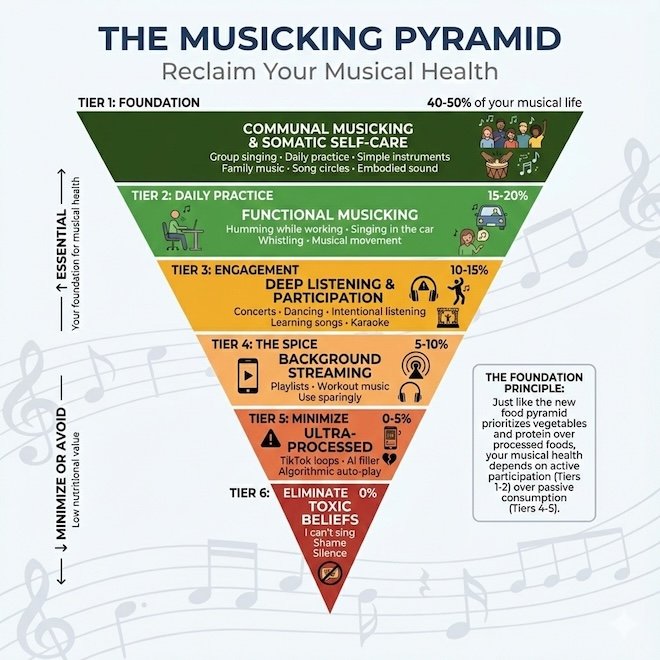
Here, I’m revealing the Musicking Pyramid – your complete nutritional guide to musical health.
The Great Pyramid Inversion
Remember when the US Health Secretary inverted the food pyramid? For decades, we’d been told to build our diets on processed grains. The new pyramid flips that entirely – vegetables, protein, and healthy fats form the foundation. Processed foods belong at the narrow bottom, used sparingly or avoided.
We need to do the same thing with music.
Visualize an inverted pyramid – a triangle pointing down. The widest part at the top is what you need most to stay musically healthy. The narrow tip at the bottom is what you should minimize.
This isn’t just metaphor. This is your actual prescription for musical wellness.
TIER 1: THE FOUNDATION (Top – Widest, Most Essential)
Communal Musicking & Somatic Self-Care
This is your vegetables and protein. This is essential. This is non-negotiable.
Communal Musicking: The Tribal Foundation
This is where the magic happens. This is where your millenia-year-old Social Brain wakes up.
What it looks like:
- Singing in community choirs (non-auditioned, open to all)
- Drum circles in parks or community centers
- Song circles and song swaps
- Family singing (bedtime songs, kitchen table harmonies, car ride sing-alongs)
- Congregational singing in religious/spiritual contexts
- Neighborhood jam sessions
- Group celebrations where everyone participates
Why this is foundation:
When you make music with other humans, you trigger ancient safety signals in your brain. Your nervous systems synchronize. Your brainwaves entrain. This is the ultimate cure for the loneliness epidemic.
This isn’t about performance. It’s not about being good. It’s about vibrating together – literally. When 10 people hum the same note, your chest cavity resonates with theirs. You become, temporarily, one organism.
The research is clear: Group singing is more effective at reducing loneliness than almost any other intervention researchers have tested. It’s more powerful than support groups, exercise classes, or therapy for creating social bonds.
How much: Several times per week if possible. At minimum, once per week.
This should occupy 40-50% of your total musical life.
Somatic Self-Care: Your Personal Practice
This is your relationship with sound as a tool for self-regulation.
What it looks like:
- Daily singing (shower, car, while cooking, to yourself, to pets, to children)
- Humming while you work or wait
- Simple instruments you can play for immediate feedback:
- Ocarina (ancient, easy, portable, beautiful tone)
- Hand drums (primal, rhythmic, embodied)
- Mountain dulcimer (folk, forgiving, meditative)
- Kalimba/thumb piano (intuitive, tactile, soothing)
- Ukulele (accessible, cheerful, quick to learn basics)
- Harmonica, Tin Whistle, Handpan, iPad
- Vocal improvisation and play
- Body percussion (clapping, stomping, chest thumping)
Why this matters:
This is auditory yoga. You’re using sound and vibration to regulate your nervous system. When you sing or play, you control your breath, engage your body, and create feedback loops between action and sound.
Unlike passive listening, this gives you agency. You’re not receiving someone else’s emotion; you’re processing your own. You’re not consuming regulation; you’re creating it.
How much: Daily, even if just 5-10 minutes. This is like brushing your teeth – basic hygiene for your nervous system.
This should occupy 25-30% of your total musical life.
TIER 2: FUNCTIONAL MUSICKING
Music Integrated Into Daily Life
This is your whole grains – valuable, sustaining, part of daily rhythm.
What it looks like:
- Whistling while you work
- Humming in the car (instead of turning on radio immediately)
- Singing while you cook, clean, garden
- Rhythmic movement coordinated with tasks
- Musical play with children (making up silly songs, rhythm games)
- Dancing in your kitchen
- Using your voice to mark transitions (hello songs, goodbye songs)
Why this is valuable:
This is about reclaiming music as a tool for flow and focus, not just entertainment. For millennia, humans sang while they worked – sea shanties coordinated hauling ropes, field hollers paced labor, lullabies soothed infants while parents worked.
You’re not “performing” this music. You’re using it functionally – to regulate mood, maintain energy, create rhythm in your day, make boring tasks pleasant. Give your brain tiny doses of musical nourishment all day long.
The shift: Instead of putting on a playlist to “get through” a task, you become the playlist. You’re active, not passive. You’re generating the soundscape of your life.
How much: Throughout your day, woven into normal activities.
This should occupy 15-20% of your total musical life.
TIER 3: DEEP LISTENING & PARTICIPATORY EXPERIENCES
Engaged Consumption
This is your occasional treat – valuable but not essential.
What it looks like:
- Attending live concerts where you participate (sing-alongs, folk shows, gospel, participatory classical)
- Deep, intentional listening sessions (not background – actually sitting and attending to music)
- Dancing (embodied musical engagement)
- Karaoke and other participatory entertainment
- Music for specific rituals and ceremonies
- Learning new songs by ear from recordings
- Exploring musical traditions with curiosity and respect
Why this has value:
There’s nothing wrong with listening – when it’s intentional rather than passive. Deep listening to music you love can be meditative, educational, inspiring. Live performances create community and support musicians.
The key difference: You’re choosing to engage, not using music as background utility. You’re present with the music, not distracted by it.
How much: A few times per month – concerts, deep listening sessions, intentional engagement.
This should occupy 10-15% of your total musical life.
TIER 4: THE SPICE (Use Sparingly)
Background Streaming & Soundtracking
This is your salt and sugar – not inherently evil, but easy to overuse.
What it is:
- Spotify playlists during workouts or commutes
- Background music while working
- “Music for focus/relaxation/sleep”
- Radio in the car
- Pleasant ambient soundscapes
Why it’s “spice”:
This is passive consumption. Music becomes wallpaper. You’re not engaging; you’re using sound as utility. It’s pleasant, sometimes helpful, but it provides minimal neurological, emotional, or social benefit. (Personally, I prefer quiet environment when working or reading.)
The algorithms have optimized this to be addictive—just engaging enough to keep you listening, but not demanding enough to require presence. It’s auditory high-fructose corn syrup.
When it’s okay:
- After you’ve done your active music-making (foundational needs met)
- When you genuinely need background ambiance
- Consciously chosen, not defaulted to
- Limited to specific contexts
How much: Occasional use, perhaps 5-10% of your musical life.
Warning: Don’t let this replace your foundation. It’s easy to spend 90% of your musical time here and wonder why you feel musically malnourished.
TIER 5: ULTRA-PROCESSED (Minimize or Avoid)
Musical Junk Food
What it is:
- TikTok earworm loops (15-second fragments)
- AI-generated background filler
- Algorithmic auto-play (removing all choice)
- Music consumed while scrolling (no attention at all)
- Sonic manipulation in marketing/retail
Why this is problematic:
- Zero active engagement
- Fragments your attention
- Trains brain for constant stimulation
- No human connection
- Can actually degrade your musical capacity through habituation to low-quality stimuli
Nutritional value: Zero to negative
Recommendation: Minimize or avoid entirely
TIER 6: TOXIC (Eliminate)
Musical Self-Deprivation
What it is:
- Believing you “can’t” make music
- Shame around your voice
- Silencing yourself
- Letting family musical traditions die
- Never singing because you’re “not good enough”
This isn’t about music – this is about your relationship to your birthright.
Nutritional value: Actively harmful
Recommendation: Eliminate this belief system entirely
Why This Pyramid Changes Everything
Here’s the revolution: This removes the “talent” barrier entirely.
If you go to a traditional music teacher, they start at the bottom of the old pyramid. They give you scales. They teach theory. They prepare you for performance. They treat music like a competitive sport where only the best get to play.
At Musicably, we treat music like nutrition.
You don’t need to be a Michelin-star chef to cook a healthy meal for your family. You don’t need perfect knife skills or culinary school.
You just need to know what your body needs, have access to real ingredients, and be willing to cook.
The same is true for music.
You don’t need to be a virtuoso to get the neurobiological benefits of musicking. You don’t need perfect pitch or years of training.
You just need to understand the pyramid, have access to simple tools (your voice, basic instruments), and be willing to participate.
When you follow this pyramid, you aren’t practicing for a stage. You are practicing for your life.
You’re building a resilient nervous system. You’re strengthening your Social Brain. You’re reclaiming a piece of your humanity that the industrial age tried to sell back to you as a luxury product.
From Concept to Action
Understanding the pyramid is one thing. Living it is another.
That’s why I’ve created a complete planning guide that shows you:
- • What a balanced week actually looks like (real example)
- • How to audit your current musical diet
- • How to design your own musically healthy week
- • Specific ideas for each tier
- • Your commitment worksheet
Download Your Free Musicking Planner PDF – below.
What’s Coming: The Musicably Mission
This is where my 40 years of musicology, music business experience, and passion for democratizing music come together.
I know that for many of you, the top of that pyramid feels impossible. You might:
- Live alone and don’t know where to find community music-making
- Have been told you’re tone-deaf and believe it
- Feel too old to start
- Not know what instruments are truly accessible
- Be intimidated by the idea of singing with others
- Not have any musical traditions to draw from
That’s exactly why I’m building Musicably.
My mission is to be your “Musical Nutritionist.” To help you move up the pyramid. To give you the tools, knowledge, and community to reclaim your birthright.
Here’s what’s coming soon:
For Solo Makers:
- Short video courses on “Birthright Instruments” like the ocarina, mountain dulcimer, and hand drums—showing you how to find your first notes in minutes, not months
- Practice guides that focus on regulation and joy, not perfection
- Song collections anyone can learn (with audio guides)
For Community Builders:
- How to start singing circles or rhythm groups in your neighborhood or family, even if you’ve never led anything before
- Templates and frameworks for creating judgment-free musical spaces
- Connection to others building musical commons in their communities
For Deep Divers:
- The Musicably membership community for ongoing support, shared learning, and accountability
- Weekly insights combining the science, the history, and the practice
- A place where “I’m not musical” becomes “I’m reclaiming my birthright”
For Everyone:
- The blog at Musicably.com with weekly posts exploring every aspect of musical recovery
- Practical guides, scientific backing, and permission-giving
- Free monthly virtual song circles where you can experience communal musicking safely
Your First Step: Download the Musicking Planner
I’m not asking you to transform your entire life overnight.
I’m asking you to see the map.
See It In Action
Want to know what this actually looks like in practice? The Musicking Planner includes:
- A complete example of a musically healthy week
- Audit worksheet to track your current musical diet
- Planning template to design your own balanced week
- Tier-by-tier activity ideas (50+ specific suggestions)
- Your personal commitment worksheet
All you need is 10 minutes to audit your current week, and you’ll immediately see where you’re musically malnourished and how to fix it.
Download the free Musicking Planner PDF below.
Print it out. Have it handy right next to your food guidelines (if you have them).
Then audit your musical life. Ask yourself:
- Where am I spending my musical time?
- Am I eating too much auditory sugar?
- Where is my protein?
- What would it look like to move 10% of my passive listening time into active making?
- Who could I make music with?
- What simple instrument could I try?
- When was the last time I sang out loud?
And then sign up for the Musicably newsletter.
I’ll send you:
- Weekly practical guidance on moving up the pyramid
- Simple musical “recipes” you can try immediately
- The science behind why this matters
- Updates on courses, community, and resources as they become available
- Permission to be imperfect, encouragement to be brave
The 60,000-year-old flute is calling you.
It’s not a call to be a “star.” It’s not a call to perform for others.
It’s a call to be human again.
Join the Movement
This is bigger than you or me. This is about reclaiming something that was taken from an entire culture.
Every person who starts humming in their car is a small rebellion.
Every parent who sings to their child instead of playing Spotify is striking a blow for human connection.
Every community that starts a song circle is rebuilding the musical commons.
Every adult who says “I’m learning to make music” instead of “I can’t” is breaking over 400 years of conditioning.
This is the Musicably mission.
Not to create more professional musicians (we have plenty).
But to restore universal participation. To rebuild the foundation of the pyramid. To cure the Great Musical Malnutrition.
Will you join us?
Download your free Musicking Planner PDF
Subscribe to get weekly guidance on reclaiming your musical birthright
Share this post with someone who thinks they “can’t sing”
The revolution starts now. With you. With your voice.
Thank you for joining me on this journey. This is just the beginning. The next chapters—the courses, the community, the tools—are coming soon. But you can start today. Right now. With a single note.
Music is Birthright, Not a Talent.
Let’s keep going: less consuming, more musicking.
Read the complete series:
- Episode 1: The Great Musical Malnutrition
- Episode 2: The 60,000-Year-Old Secret in Your Throat
- Episode 3: The Shared Brain and the Loneliness Cure
- Episode 4: The Reveal—Your Musicking Pyramid (you are here)
Ready to start? Download the Pyramid PDF below | Join the Newsletter
And if you prefer, you can tune in to this and previous episodes of the Musicably podcast to listen to more about the science of brain fireworks and how you can begin your journey toward a well-nourished sonic life. Musicably Podcast is also at Apple, Spotify, Amazon, and YouTube.
Picture by Gemini
