


The 60,000-Year-Old Secret in Your Throat
Last week, we talked about “The Great Musical Malnutrition” – how we’re gorging on digital ear-candy while our biological selves starve. Today, I’m taking you deep into a Slovenian cave to show you why music isn’t a hobby. It’s a survival technology older than our own species.
The Bone That Changed Everything
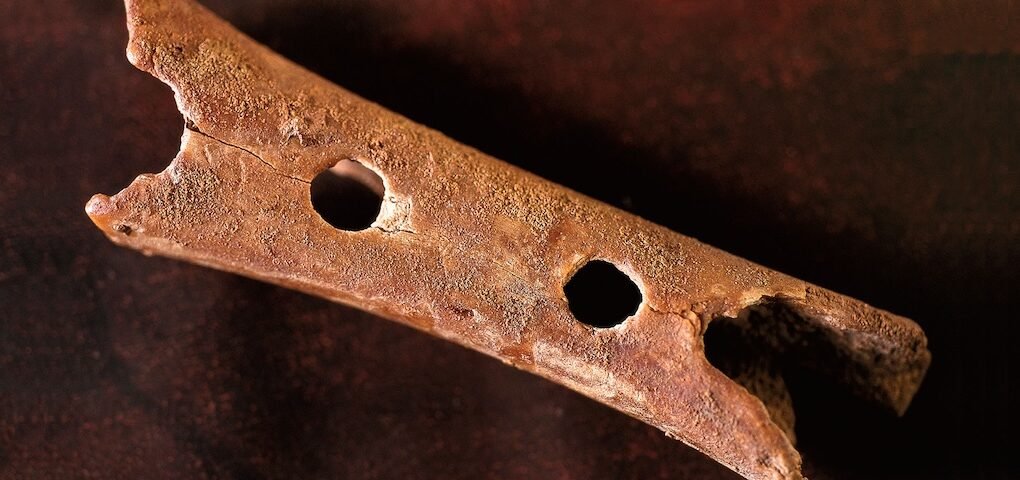
High in the mountains of Slovenia, in Europe, there’s a jagged limestone opening called Divje Babe cave. In the mid-1990s, archaeologists digging through frozen layers of ancient sediment found something extraordinary.
At first glance, it looked like trash – a fragment of a cave bear’s thigh bone, weathered and worn. But when they cleaned away 60,000 years of dirt, they saw something that would ignite decades of debate: four precisely placed, circular holes.
For years, skeptics tried to dismiss it. “Just a bone chewed by hyenas,” they said. “Neanderthals weren’t sophisticated enough to make music.”
But recent research, including re-dating in the 2020s, has settled much of the debate. This wasn’t a predator’s leftovers. This was a flute. And it’s between 60,000 and 65,000 years old.
That means it was crafted roughly 20,000 years before modern humans (Homo sapiens) even arrived in Europe.
Let that sink in for a moment.
While you sit in your car listening to Spotify, or scroll through TikTok with earbuds in, you’re connected to a musical lineage that predates your own species. Music isn’t a recent cultural invention like the printing press or the internet.
Music is a survival technology that is older than modern humanity itself.
Your Body: Built for Sound
We’ve been told for hundreds years that music is a “talent” – something you either have or you don’t. The industry has spent centuries convincing you that unless you’re gifted, you should just sit quietly and listen to the professionals.
But when we look at the biology of a 60,000-year-old Neanderthal and compare it to yours, we see a different story.
Your body is literally engineered for music-making.
The Hardware: Your Throat Was Made for Song
There’s a tiny bone in your throat called the hyoid. It’s unique – the only bone in the human body that doesn’t connect to any other bone. It floats there, anchoring your tongue and voice box, allowing the precise movements needed for speech and song.
For decades, scientists assumed Neanderthals couldn’t sing or speak complexly because their anatomy was “primitive.” Then we found their hyoid bones.
They’re virtually identical to yours.
Same structure. Same position. Same capacity for the intricate vocal control that singing requires.
The Software: You’re Genetically Wired to Music
Then there’s the genetics. We all carry a gene called FOXP2, often called the “language gene.” But that’s misleading. It’s actually the “sequential motor control” gene – it’s what allows your brain to coordinate your mouth, lungs, and vocal cords in precise, rhythmic sequences.
The kind of sequences you need for speech. And for song.
Neanderthals had the exact same version of that gene we do.
Think about what this means: Before we were building cities, before we were even Homo sapiens, our evolutionary cousins were already biologically equipped to modulate pitch and rhythm. They were making music tens of thousands of years before we invented writing.
And it goes back even further. Just weeks ago, archaeologists re-identified a roughly 500,000-year-old hammer made from mammoth bone at Boxgrove in England. It shows sophisticated planning, material knowledge, and skill transmission—the same cognitive capacities required for music-making. Our ancestors may have been musical for half a million years.
This is what I mean when I say Music is a Birthright.
Your throat wasn’t designed just for swallowing. It was shaped for song. Your ears weren’t built merely to detect predators. They evolved for harmony, for rhythm, for the subtle emotional prosody that binds human communities together.
You weren’t born without musical ability. You were born with it. You were just taught to believe otherwise.
Dismantling the “Auditory Cheesecake” Myth
In the 1990s, Harvard psychologist Steven Pinker wrote something that made a lot of musicologists – myself included – very frustrated.
He called music “auditory cheesecake.”
His argument: Music is a useless evolutionary accident. We evolved language for survival, and music just “piggybacked” on those brain systems because it feels good – the same way we evolved to seek nutrients, and cheesecake hacks those cravings with concentrated sugar and fat.
According to Pinker, music is biological junk food. Pleasant, but unnecessary.
Pinker was wrong. And three decades of neuroscience and anthropology have proven it.
Here’s the difference: You can live without cheesecake. You can live without any dessert at all. Millions of people do.
But in 60,000-plus years of human history, no human culture has ever been found that didn’t have music. Not one. Not ever.
Even in environments where every calorie and every minute mattered and survival was never guaranteed – the brutal Ice Age Europe, Arctic hunting cultures, desert nomads – our ancestors weren’t wasting precious energy on “dessert.” They devoted scarce time and energy to singing, chanting, drumming, and dancing – because it served essential functions.
Music Came Before Language
Anthropologists like Steven Mithen have proposed a more compelling story. Something he called the “Hmmmm theory” – which stands for “Holistic, Manipulative, Multi-modal, Musical, and Mimetic” communication.
The idea: Before we had specific words for “I am hungry” or “Danger approaching,” hominins communicated primarily through melodic, rhythmic, emotionally charged vocalizations. We used pitch, rhythm, and timbre to convey our internal states to one another. We might call it now musical prosody.
Music wasn’t an afterthought that came after language. Music was the foundation that language built upon.
Your voice’s ability to rise and fall in pitch, to speed up and slow down, to carry emotion beyond words – this isn’t decoration. It’s the original human communication technology.
When you sing to your child, you’re not doing something cute or optional. You’re using the oldest language our species has: the language of melody and rhythm that predates words.
The Ancient Scale Still Singing in Your Bones
Here’s where it gets truly mind-bending.
When musicologists and acousticians analyzed the spacing of those holes in the Divje Babe flute, some researchers found something startling. While the interpretation remains debated among scholars, analysis suggests the hole spacing may correspond to intervals found in the diatonic scale – the “Do-Re-Mi-Fa…” system we still use today.
If this interpretation is correct, it means our modern musical structures aren’t just arbitrary “Western” inventions from the last few centuries.
They’re resonances that were discovered – or perhaps rediscovered – by our evolutionary cousins over 60,000 years ago. They may be vibrational patterns that emerge naturally from the structure of the hominid brain and vocal tract.
When you hum a simple melody today – even if you think you’re “bad at music” – you’re potentially tapping into a sonic heritage that has been echoing through caves and forests for at least sixty millennia.
You’re not inventing something new. You’re remembering something ancient.
So Why Do You Think You Can’t Sing?
If music-making is truly your birthright, hardwired into your biology and your genes, why do so many people now feel they “can’t sing,” or that they are “not musical”? “Untalented”?
Why does the thought of singing in front of others fill you with shame or anxiety?
One big reason is that we have narrowed music into a performance commodity: something done by specialists for an audience.
Because you’ve been taught that music is performance for evaluation.
But for the Neanderthal with the bone flute, and before that for our Homo heidelbergensis ancestors with their sophisticated tools, music wasn’t about impressing an audience. It was about:
- Regulating emotion: Processing fear, grief, and joy beyond what words could express
- Bonding with family: Singing to children, coordinating with the group
- Creating meaning: Marking rituals – births, deaths, seasons – the moments that mattered
- Synchronizing group action – hunting, rowing, marching, working
- Staying sane: In a world actively trying to kill them, music was emotional medicine
Music was survival. Music was connection. Music was sanity.
Not entertainment. Not product. Not performance.
In modern language, we might say: music was a nervous‑system technology and a social glue, long before it was an industry.
The shame you feel about your voice? That’s not biology. That’s 400 years of cultural conditioning telling you that unless you sound like a professional, you should stay silent.
It’s the same lie we explored in last week’s post about Musical Malnutrition: that music is for the talented few, and the rest of us should just consume.
But your Neanderthal cousins didn’t have Spotify. They had their voices, their hands, their breath. And they used them because they had to.
You have the same equipment they did. The same genes. The same floating hyoid bone. The same FOXP2 sequence.
We are living in a culture that has outsourced musicking to professionals and recordings, while your ancient biology still expects you to participate.
The only thing you’re missing is permission.
The Question We Haven’t Answered Yet
We’ve established the hardware – your body is built for music.
We’ve seen the evidence – music is at least 60,000 years old, possibly 500,000.
But one question remains: Why?
Why did evolution invest so heavily in musical capacity? Why shape our throats, wire our brains, and preserve these abilities across hundreds of thousands of years?
The answer lies in something scientists call the “Social Brain Hypothesis.”
Next week, we’re going to explore what happens when two people make music together. We’re going to talk about “The Shared Brain” – the phenomenon where two people’s neural activity literally synchronizes into a single frequency when they sing or play together.
I’m going to show you why making music with others is one of the most powerful interventions for mental health, loneliness, and cognitive function that we know of.
We’re going to talk about the chemical “social glue” that has dissolved in our digital age – and how we can get it back.
We’re going to bring this 60,000-year story into the present day, into your kitchen, your car, your community.
Your Homework: Touch the Ancient
Before next week, I want you to do something simple.
Find a physical object. A tabletop. A wooden spoon. A hollow tube. A bone if you happen to have one lying around.
Tap a rhythm on it.
Don’t worry about whether it’s “music.” Don’t judge whether it’s “good.” Just feel the vibration. Listen to the sound your body creates when you strike something in a pattern.
You’re doing something your ancestors did 60,000 years ago. Maybe 500,000 years ago.
You’re not a consumer of other people’s creativity.
You are an ancient, resonant being.
Your throat carries 60,000 years of song. Your hands remember rhythms older than language. Your ears evolved to find harmony in chaos.
This isn’t metaphor. This is biology. This is your birthright.
Stop waiting for permission to claim it.
This is the mission of Musicably: to help you reclaim music as birthright, not talent. Music isn’t auditory cheesecake. It’s not a luxury or a hobby. It’s a survival technology woven into your DNA, waiting for you to remember how to use it.
Next week: The Shared Brain—why singing with others is the most powerful thing you can do for your mental health.
Music is Birthright, Not a Talent. Let’s reclaim it together.
And if you prefer, you can tune in to Episode 1 of the Musicably podcast to listen to more about the science of brain fireworks and how you can begin your journey toward a well-nourished sonic life. Musicably Podcast is also at Apple, Spotify, Amazon, and YouTube.
