


Two Threats to Music’s Future: Forced Lessons and AI Generation
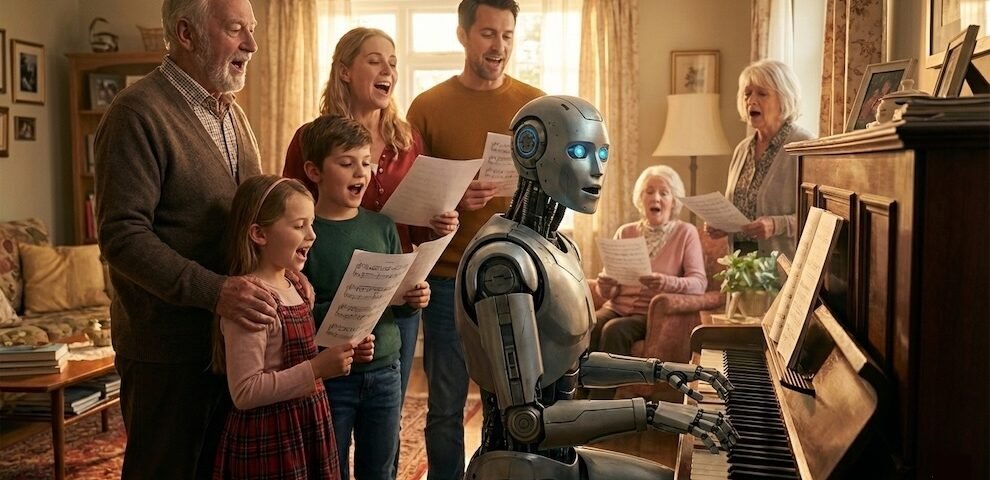
We’re losing music. Not recorded music – we have more of that than ever. We’re losing something far more precious: the living tradition of making music together as families and communities. And ironically, two seemingly opposite forces are accelerating this loss: well-meaning parents forcing music lessons on unwilling children, and AI platforms like MusicGPT making it effortless to generate music without human participation.
Both threaten to transform music from something humans do together into something we either endure or consume. Let me explain.
The Forced Lesson Paradox
I’ve spoken with many parents who genuinely want their children to learn music and play an instrument. I’m grateful for this – it shows they recognize music’s value. But there’s a troubling pattern I encounter repeatedly:
The children are forced to take lessons. Forced to practice. Forced to perform at recitals. Music becomes homework, another obligation in their overscheduled lives. And predictably, once these kids gain independence – whether at college or simply when parents stop monitoring – they happily abandon the instruments they spent years “learning.”
The parents are often shocked. “But we invested so much money in lessons! They were getting good!”
So I ask them a question that makes many uncomfortable:
“How much music do you make naturally in your home? Do you sing together? How often do you spend time making music as a family – just for joy, not for lessons or improvement?”
The responses are telling. Many parents acknowledge they don’t make music together. Some admit they don’t even like music much themselves. A few become defensive, as if I’m judging their parenting.
But here’s what I’m really asking: If music isn’t a living, joyful part of your family’s daily life, why would your children want to continue once the external pressure disappears?
What Music Was in My Family
I grew up in a family where singing together was a regular occurrence, especially when we gathered with extended family. Nobody was a professional musician. Nobody forced it. It just happened – the way families eat meals together or tell stories.
We sang folk songs, traditional songs, whatever came naturally. Sometimes badly, sometimes beautifully, always together. Music wasn’t something you “learned” in isolation and then performed for approval. It was something you did because it felt good, because it connected us, because it was simply part of being together.
That’s the tradition we’re losing. And no amount of forced piano lessons will preserve it.
The Real Problem
When parents force music lessons without making music a natural part of family life, they’re teaching their children that music is:
- An obligation (something you have to do, not want to do)
- A performance (something you do for others’ approval)
- A solitary activity (practice alone in your room)
- A skill to acquire (not an experience to enjoy)
- Someone else’s thing (Mom and Dad make me do this, but they don’t do it)
Is it any wonder these children abandon music the moment they can?
The sad irony: these parents think they’re giving their children music. But they’re actually teaching them that music is drudgery—something to escape from, not embrace.
What Would Work Instead
If parents truly want their children to carry music into adulthood, they need to ask themselves:
Do we make music together as a family?
Not “does my child take lessons.” Not “do we listen to music in the car.” But: Do we actively make music together?
This doesn’t require being musical. It doesn’t require lessons. It requires:
- Singing together (in the car, while cooking, before bed)
- Playing simple instruments together (kazoo, drums, ukulele, anything)
- Dancing together to music you love
- Making up silly songs
- Improvising rhythms while walking
- Having music be part of celebrations, not just special occasions
When children grow up experiencing music as a joyful social activity – something the people they love do together naturally – they don’t need to be forced. They want to explore music because it’s already woven into their understanding of connection and joy.
Then, if they choose lessons, it’s to deepen something they already value, not to acquire a skill their parents value.
The AI Threat: MusicGPT, Suno and the Death of Musicking
Now let’s turn to the other threat: artificial intelligence that generates music.
Platforms like MusicGPT, Suno and others are making it trivially easy to create “music” without any human music-making. Type a prompt, get a song. No instruments, no singing, no learning, no practice, no collaboration. Just instant audio content.
Some of these platforms even claim they won’t assert copyright over generated music, making it even more attractive for commercial use. Why hire musicians when AI can generate a soundtrack for your video in seconds?
And the situation is getting more complicated. As it looks like, the traditional music companies are just “smelling” money in the AI. So the Udio AI got acquired my the Universal Music Group, and Suno is facing signicitact copyright infringement lawsuits, while simultaneously securing major funding and striking an innovative licensing deal with Warner Music Group. Music companies have mostly abandoned an effort do develop new artists – they are in the music business just to make money. And the AI will make it much easier for them. Why would they care about music and musicians?!?
Why This Could Kill Music
“But Palo,” you might say, “there will always be music. AI just makes it more accessible!”
Here’s what I fear:
If we can generate infinite music without making any ourselves, why would anyone bother to actually make music?
We’re already a culture of passive music consumers. Most people spend their lives listening to music but never making any. They stream playlists, attend concerts, maybe tap their feet – but they rarely experience the profound difference between consuming music and creating it.
AI accelerates this trend to its logical conclusion: Why learn an instrument when AI can play better? Why sing when AI vocals sound more polished? Why practice when AI can generate exactly what you want instantly?
Music as Product vs. Music as Activity
This brings us back to a fundamental question: What is music?
If music is a product – audio content to be consumed – then AI is simply a more efficient production method. Why would we oppose that?
But if music is an activity – something humans do together to connect, express, coordinate, and create meaning – then AI-generated audio isn’t music at all. It’s just sound.
Music, in its truest sense, is artful auro-kinetic social activity. It’s:
- Artful (intentionally crafted by humans)
- Auro-kinetic (sound connected to bodily movement)
- Social (done with and for others)
- Activity (something you DO, not consume)
AI can produce audio. But it can’t produce musicking – the active, embodied, social experience of making music together.
The Copyright Question
Some might argue that platforms not claiming copyright is actually good – it democratizes music creation. But I see it differently.
When AI-generated audio floods the market:
- Working musicians lose livelihoods (why pay a human when AI is free?)
- Musical skills become devalued (years of practice can’t compete with instant generation)
- Music becomes even more commodified (just another content type to generate and consume)
- The tradition of music-making erodes further (fewer people have reason to learn)
And most critically: The experience of making music – the thing that actually matters for human wellbeing, connection, and culture – disappears entirely from the equation.
We’re left with infinite audio content and zero musicking.
A World Without Musicking
Imagine a future where:
- Children grow up never making music, only consuming AI-generated audio
- Families never sing together because “AI does it better”
- Communities don’t gather to make music because they can just generate playlists
- No one learns instruments because “what’s the point?”
- Music becomes something only professionals do, then eventually something only AIs do
- And finally, “music” becomes just another form of passive entertainment, completely divorced from human participation
That’s not a future with music. That’s a future where music – real music, human music, musicking – is dead.
The Common Thread
These two threats – forced lessons without family musicking, and AI-generated audio replacing human music-making – share a common problem:
Both treat music as something separate from lived experience.
Forced lessons treat music as a skill to acquire for future performance, not a joy to experience now.
AI generation treats music as content to produce for passive consumption, not an activity to participate in.
Both miss the essential point: Music is something humans do together, for the sheer joy and connection of doing it.
What We Need to Preserve
If we want music to survive – not as audio content, but as a living human tradition – we need to:
In Families:
• • Make music together regularly (singing, playing, creating)
- Model music as joy, not obligation (parents, do YOU make music?)
- Let lessons serve participation, not replace it (if children want to deepen their engagement)
- Prioritize informal musicking over formal performance
In Culture:
• • Resist the equation of music with audio content
- Teach the difference between making music and generating audio
- Value participatory music-making (drum circles, singing groups, jam sessions)
- Support music as social activity, not just entertainment product
With Technology:
• • Use AI as a tool to support human music-making (practice aids, learning tools, accompaniment)
- Reject AI as replacement for human music-making
- Insist on the irreplaceable value of embodied, social musicking
The Choice We Face
We’re at a crossroads. One path leads to:
- Music as obligation for children, abandoned in adulthood
- Music as AI-generated content, passively consumed
- Musicking as a lost tradition, something only historians study
The other path leads to:
- Music as natural family and community activity, carried into adulthood
- Music as human creative expression, actively participated in
- Musicking as living tradition, something everyone experiences
The first path is easier. Let institutions handle music education. Let AI handle music production. Let parents outsource musical experiences.
The second path requires intention. Families must choose to sing together. Communities must choose to gather and make music. Individuals must choose active participation over passive consumption.
My Plea
To parents: Before you force another piano lesson on your unwilling child, ask yourself – when did we last make music together, just for joy? Can you model the very thing you’re trying to give them?
To everyone: Before you let AI generate another piece of “music,” ask yourself – when did I last actually make music with other humans? Have I experienced the profound difference between consuming audio and creating sound together?
Music is not something we have. It’s something we do.
And if we stop doing it – whether because we’ve made it obligatory drudgery for children, or because we’ve outsourced it to algorithms – we won’t just lose music.
We’ll lose a fundamental part of being human.
Music is artful auro-kinetic social activity. It’s something humans do together with our bodies, our voices, and our creativity.
No amount of forced lessons or AI generation can replicate that. And no amount of recorded perfection or algorithmic efficiency can replace it.
The question is: Will we choose to keep musicking alive?
Or will we let it die while drowning in an ocean of audio content we call “music” but never actually make?
Photo Nano Banana
