


What Is Music, Really?
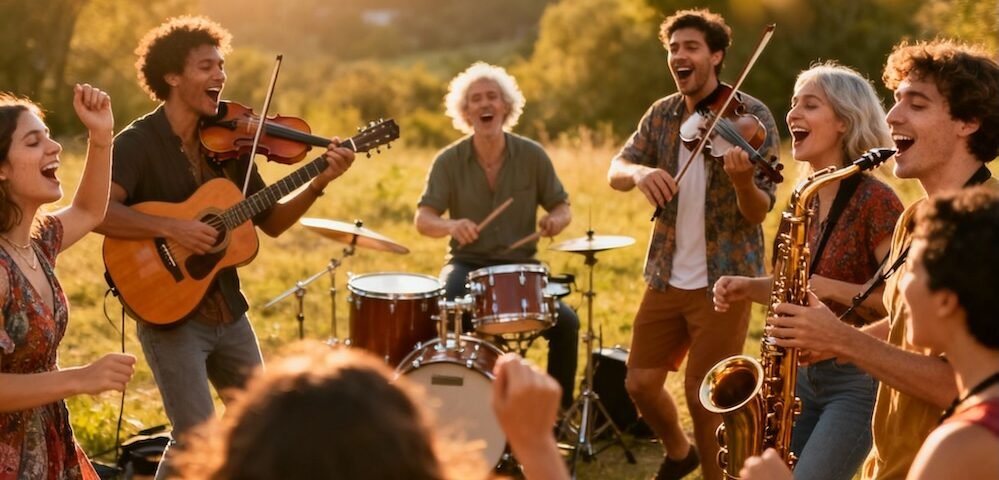
Recently I found a very interesting, nicely short, and right-to-the-point definition of music. I really liked it, but thought that there was just a one more piece missing. So I have played with it for a while, and think the result is quite satisfactory. What do you think?
_ _ _
We live in an age of musical abundance. Algorithms curate endless playlists. AI generates “music” on demand. We stream, shuffle, and skip through millions of tracks while commuting, working, or relaxing. Music has become something we consume – a product delivered to our ears for our pleasure and convenience. (And for rather substantial financial benefits of ever smaller group of “beneficiaries”.)
But is that really what music is?
The Ancient Pulse
Long before Spotify, before concert halls, before even written notation, our ancestors gathered around fires. They sang together. They drummed. They moved in synchrony, their voices and bodies creating patterns of sound and motion that bound them together. A mother hummed to soothe her infant. A community chanted to coordinate their work. Warriors danced before battle, their rhythmic movements aligning breath, heartbeat, and collective resolve.
This wasn’t entertainment. It wasn’t a product. It was something humans did together – something essential to survival, bonding, and meaning-making.
Evolutionary researchers like Steven Mithen, Ian Cross, and Iain Morley have explored why music emerged in human development. Their work suggests music didn’t evolve to create passive listeners. It evolved because moving and sounding together – synchronizing our bodies and voices – created powerful social bonds, emotional regulation, and group coordination. Music was participatory, embodied, and collective from the very beginning.
The Participatory Gap
Somewhere along the way, we developed a split. On one side: professional musicians who perform. On the other: audiences who sit quietly and listen. This division intensified with recording technology. Suddenly, music could be bottled, sold, and consumed without anyone actually making it in the moment.
Don’t misunderstand – there’s nothing wrong with listening to recorded music or attending concerts. But when we think of music only as something to consume, we miss its deeper nature. We forget that for most of human history, and in many cultures today, music meant everyone participated. You didn’t have to be “good at it.” You simply joined in.
Christopher Small coined the term “musicking” to capture this active dimension – music as something we do, not just something we have. Musicking is participatory music-making: singing with others, drumming in a circle, dancing together, clapping along, humming while you work. It’s the act of creating sound and movement collectively, not for an audience, but as a shared experience.
What AI Can’t Do
The rise of AI-generated music makes this distinction urgent. AI can now compose, arrange, and produce tracks that sound impressively musical. But here’s what AI can never do: feel the vibration of a drum in your chest, synchronize your breath with fellow singers, experience the joy of collective rhythm moving through your body, or forge social bonds through shared music-making.
AI produces audio content. Humans make music.
When we participate in music-making – when we musick – something profound happens. Our nervous systems synchronize. We regulate emotions together. We build trust and belonging. We coordinate and communicate in ways that transcend words. This is why lullabies soothe infants, why protest songs unite movements, why drum circles feel transformative, why singing together in religious services creates community.
None of this happens when we passively stream AI-generated tracks through earbuds.
The Definition We Need
So what is music, really? Not the product, not the recording, not the algorithm-generated audio—but the thing humans have been doing together for tens of thousands of years?
Music is artful auro-kinetic social activity.
Let’s unpack that:
Artful means it’s intentionally crafted, shaped with care and skill, designed to be beautiful or meaningful. It’s not random noise.
Auro-kinetic combines sound (aural) with movement (kinetic). Music makes us move—tapping, swaying, dancing. And movement shapes music – breathing, drumming, the physical act of singing or playing.
Social activity means it’s something we do together. Even when we make music alone, we’re drawing on socially learned traditions, and often imagining or remembering shared musical experiences.
Activity is key. Music isn’t primarily something to consume. It’s something to do, to participate in, to make happen with our bodies and voices in coordination with others.
Reclaiming Music
This definition isn’t meant to dismiss recorded music or professional musicianship. Both have their place. But it’s a reminder that the heart of music – its evolutionary purpose, its deepest human value – lies in participatory music-making.
You don’t need talent. You don’t need training. You don’t need to perform for anyone. You just need to participate: sing in the shower, drum on the table, hum with your child, join a community chorus, clap along at a concert, make up silly songs with friends.
In an age where AI will flood the world with endless audio content, we need to remember what makes music uniquely, irreplaceably human. We need to reclaim music as something we do together, not just something we consume alone.
So the next time you find yourself streaming music passively, consider this: Are you experiencing music? Or are you just hearing sounds?
Because artful auro-kinetic social activity – the thing humans have been doing together since before language, the thing that binds us, moves us, and makes us human – that’s not something you can outsource to an algorithm.
And if you haven’t realized it yet, that artful auro-kinetic social activity is… MUSIC!
Picture: by Perplexity … will you find the funny part??
