


Why Choirs Make Us Cry
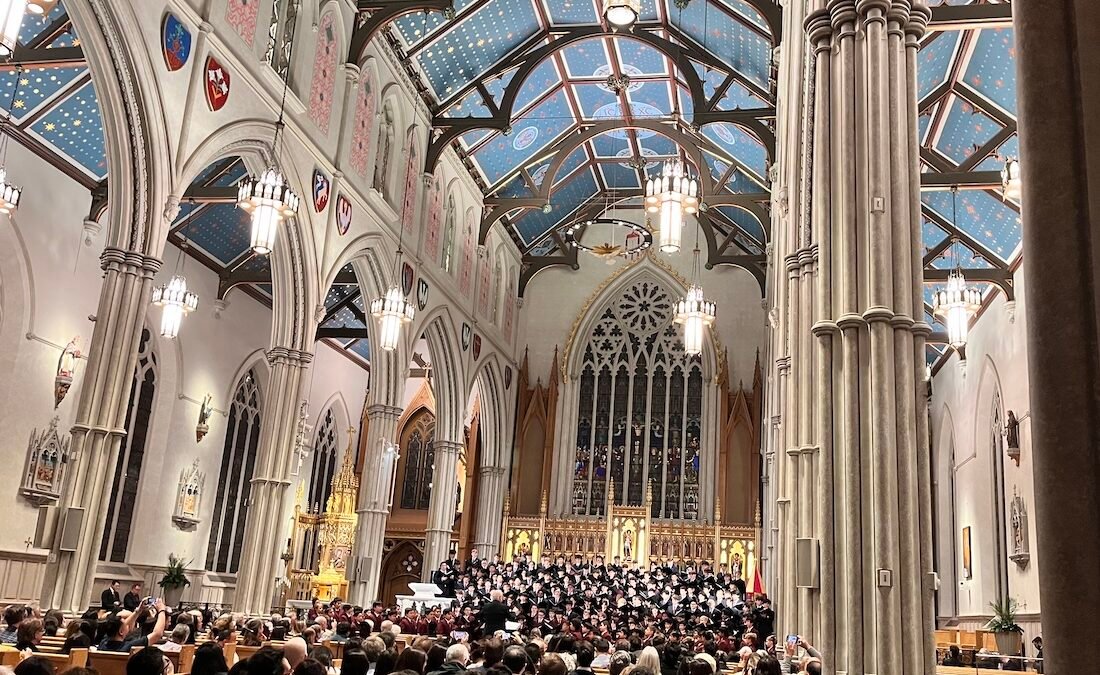
This week, someone in our choir parents’ WhatsApp group reshared a phone recording of our boys singing Gustav Holst’s “I Vow to Thee, My Country.” It was from the big concert last spring, the last major performance for our sons’ class before they graduated from Grade 8 at St. Michael’s Choir School. Watching it again, I felt a wave of pride.
As we were reminiscing, few parents mentioned goosebumps and tears. One put it this way:
“Every time I sit down again to listen to the boys’ choir, I have the same reaction. No emotion, neither happy nor sad, but goosebumps and watery eyes.”
That caught my attention as a musicologist. How can the body react so strongly while the mind reports nothing? Here is my thinking on it. If you have felt this, you are not missing anything. Something real and fascinating is happening.
1. We name feelings by their stories
Most of the time, we label an emotion by its cause. We are happy because of good news. We are sad because of a memory.
A choir often gives us the feeling without the cause. The music arrives and the body answers. The mind looks for a reason and finds none, so it says, “I guess I’m not feeling anything.”
The words of this hymn do tell a story, about devotion and sacrifice. But when children sing, most of us stop following the text. We take in the sound. The feeling comes first and the label never shows up.
My view is that the emotion is there. The name for it is missing.
2. It is not the cathedral, and it is not the speaker
Here is the part I find most interesting. This was a recording played on a phone. The tiny speaker cannot carry the stone walls, the high ceiling or the sense of sound coming from everywhere. Whatever caused the chills, it was not the room itself.
What survives is the voices. Treble voices have little vibrato, so a whole choir on one line blends into a single clear sound. A phone can still pass that on. So can a melody built to rise and then settle.
And we are not hearing it as strangers. Many of us attend these concerts every time. We sit in that cathedral for the weekly masses. We know these boys by name. A small recording can act like a key. It opens the memory of the room, the candles, the faces, and we feel them all at once. Researchers who study music and autobiographical memory have found that familiar music can bring back whole scenes in this way.
3. Several feelings at once can sound like none
This was also the last big concert of the elementary years. For parents, that is a lot to hold. There is pride, and there is joy. The boys are moving on together, which is a gift. But we also know they are growing up fast, and that the treble sound we love belongs to childhood. Many of these boys have already moved from soprano or alto to bass since that concert.
I suspect that when feelings pull in different directions, they can blur into something we cannot call happy or sad. It is a mixed feeling, and “nothing” can be the closest word we have for it. This is only my reading, but it fits what probably many parents say at moments like this.
4. Tears are not the same as sadness
We tend to treat crying as a sign of sorrow. Music research suggests it is more than that. Studies by music psychologists found that listeners often cried at certain melodic moments, such as a note that leans and then resolves, and felt chills at sudden shifts in the harmony. None of that needs a sad story.
Psychologists also describe the experience of being moved. It is a response to something meaningful, and it can show up as tears, a warm chest or a lump in the throat. It sits beside happy and sad rather than inside either one.
5. Awe makes us feel small, in a good way
Psychologists have studied awe for years. They describe two parts. We meet something larger than ourselves, and our picture of the world has to stretch to fit it.
Later research found that awe makes people feel like a small part of something bigger. Worry about the self fades and attention moves outward.
That may be what stillness at a choir concert is. You are not planning or judging. You are simply listening. It feels like “no emotion” because it is so different from our busy, everyday feelings.
Why music is different
Awe comes from many places. A mountain, a great building or a night sky can all do it. But goosebumps and tears are another matter. For many of us, music is where they happen most reliably. Film leans on its soundtrack. Poetry asks the thinking mind to work first. Music arrives in time, one moment after another, and the body answers before the mind can get involved.
Some pieces do this every time. Others only work once, when the surprise is new. Either way, a choir has one more advantage. The human voice is the sound we know best, and here dozens of people breathe together and become one voice. I think that is why this music can move us so deeply, even through a phone speaker.
What we are really hearing
There is one more layer, and for me it is the most important. These boys work at this nearly every day. They learn to match their vowels. They learn to breathe together and tune to each other by ear. They do it year after year, and they do it at an age when most children cannot sit still for ten minutes.
A great choir sounds effortless because so much effort went into it. I think we can hear that, even through a phone speaker. The goosebumps may be our response to the music, and they may also be our response to the work.
So if you felt chills and tears without a name for the feeling, take it as a compliment to the boys and to everyone who taught them. You did not miss the emotion. You felt something so large that language needed a moment to catch up.
+ + +
For the curious: the researchers behind these ideas are John Sloboda (music and emotion), Dacher Keltner and Jonathan Haidt (awe) and Paul Piff (awe and the sense of a smaller self). Keltner’s book Awe is a good place to start.
Photo by Palo Beka
