


Why Musicking Makes You Smarter at Any Age
What Einstein, Planck, and Feynman Never Forgot
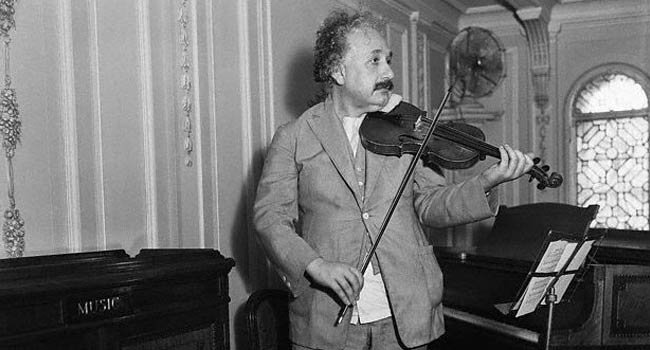
Albert Einstein played violin every single day. Not when he was young and still figuring things out. Throughout his adult life, in the middle of his most important work. When his thinking hit a wall, he would put down the physics and pick up the violin. His son reported that the music was not a break from the thinking. It was where the thinking happened.
Thomas Jefferson practiced violin three hours a day. Not as a student. As a sitting president. He called music his “favourite passion” and maintained the practice through the most demanding period of his public life.
Richard Feynman played bongo drums compulsively. He talked about rhythm, pattern, and intuition as the same quality of mind, whether applied to physics or percussion. The bongos were not a hobby. They were how one of the most creative scientific minds of the twentieth century stayed connected to itself.
Howard Gardner spent decades at Harvard studying the nature of human intelligence. He was also a lifelong pianist. When he published his theory of multiple intelligences, Musical Intelligence sat alongside logical-mathematical and linguistic ability as one of the fundamental forms of human cognition. For Gardner it was not incidental that music had this status. His own life had already shown him what his research would later confirm.
Max Planck, the German physicist who founded quantum theory and stood alongside Einstein as one of the two greatest scientists of the twentieth century, was a pianist, organist, and cellist with absolute pitch. At seventeen he faced a genuine choice between physics and a professional music career. He chose physics. But he never stopped playing. His Berlin home became a gathering place for the greatest scientific minds of the era – and they made music together. Einstein played violin. Planck accompanied him on piano. Two men who rewrote our understanding of the universe, playing Beethoven sonatas in a sitting room. Planck said it plainly: “It is not logic, but the creative imagination which ignites the first flash of insight in the spirit of the researcher.”
These are not coincidences. And this is not the argument you may be expecting.
I am not going to tell you that playing music made Einstein a genius. That is the kind of claim that sounds good in a headline and collapses the moment you look at it. Plenty of people played violin in the twentieth century and did not develop the theory of relativity. Correlation is not cause. You already know that.
What I want to tell you is something different. Something more interesting. And something far more useful to you.
These people played because they knew, at some level they may not have been able to fully articulate, that it made them better. Not smarter in some vague general sense. Better at accessing what was already in them. The music was not decoration. It was operational.
Now there is a scientific framework that explains exactly why.
In the 1990s, a psychologist named Phillip Ackerman proposed what he called PPIK theory. The name is awkward. The idea is not.
Ackerman’s starting point is simple. Raw intelligence, the kind measured by IQ tests, peaks in late adolescence and then slowly declines for the rest of your life. If raw processing power were the whole story, a brilliant 60-year-old would be a contradiction. We know from experience that this is not how intelligence works. So something else must be happening.
Ackerman called it the investment theory of intelligence. Raw processing power is starting capital. What matters in the end is not how much you start with. What matters is what you do with it. Every time you engage deeply with something difficult, your raw processing power gets converted into something more durable. Permanent knowledge. Automatic competence. The kind of understanding that does not require you to reason from scratch every time, because the answer is already built in. Ackerman called this Intelligence-as-Knowledge, and unlike raw processing speed, it does not decline. It compounds.
The question that follows immediately is: if everyone has this processing power to invest, why doesn’t everyone invest it? Two reasons, says Ackerman. Personality and interests.
The personality factor is the one he calls typical intellectual engagement. Whether you actually enjoy difficult thinking, or instinctively avoid it. This sounds like a fixed trait. Ackerman’s research shows it behaves like a habit. It can be built. You build it by repeatedly choosing the harder option and then allowing yourself to feel the reward when something difficult finally clicks into place.
The interest factor is where it gets interesting for us.
Ackerman’s research, drawing on the vocational work of psychologist John Holland, found that two interest patterns are especially powerful drivers of adult knowledge development. Investigative interests, the drive to understand how things work. And artistic interests, the orientation toward creativity, expression, and aesthetic complexity. Music lives squarely inside that second category.
People whose personality and interests cluster around these patterns build knowledge dramatically faster. Not because they are more intelligent. Because their ability, personality, and interests are all pushing in the same direction at once. Ackerman calls this an intellectual-cultural complex. Einstein. Planck. Jefferson. Feynman. They were not just exceptionally intelligent people who happened to play music. They were people whose artistic engagement and intellectual life were part of one unified operating system.
Before I go further, I want to address something you may be thinking. Wasn’t there a study about Mozart making people smarter? Didn’t Don Campbell write a whole book about it?
Yes. And no.
The Mozart Effect, as it entered popular culture, is not a musicking story. It is a passive listening story. You play Mozart in the background and something temporarily improves in a narrow spatial reasoning test. The effect was small, it was temporary, and the popular version of it departed from the actual science so far that researchers spent years trying to correct the record.
What I am describing is the opposite of that. Not music received. Music made. Not passive. Active. This distinction is not minor. It is the whole point.
So what does the research actually support?
Active musicking builds executive functions. Working memory. Inhibitory control. The ability to hold competing ideas, filter distractions, and sustain focused attention. These are not musical abilities. They are the architecture that underlies intelligent performance in every domain. And they transfer. The sustained, effortful engagement that musicking requires builds them in ways that do not stay locked inside music. They move outward into your thinking, your reading, your capacity to stay with a hard problem.
Beyond that, neuroscientist Nina Kraus at Northwestern University has spent decades showing that active musical engagement physically changes how the nervous system processes sound, and that this change cascades into language comprehension, reading, and attention. The nervous system trained by musicking becomes a more finely calibrated instrument for making sense of a complex world.
And then there is Ackerman’s compounding mechanism, which may be the most important claim of all for anyone in the second half of their life. Musical knowledge, once built, accumulates on itself. Pattern recognition that required effortful attention becomes automatic and frees resources for higher-level musical thinking. That compounding interacts with everything else you already know. The 54-year-old who begins musicking seriously is not starting from zero. They are connecting new musical knowledge to five decades of accumulated life knowledge, emotional understanding, and hard-won insight across many domains. The result is not a slow learner. It is someone building on a richer existing structure than any 20-year-old possesses.
But there is a third claim. One that Ackerman does not make explicitly, but that I believe the evidence supports and that years of working with adults in music has shown me directly.
Ackerman assumes that the intellectual-cultural complex, the cluster of artistic interests, openness, and genuine engagement with difficult thinking, is simply something you have or you don’t. What I have observed is something different. The orientation is often not absent. It is suppressed. It was there in childhood. It survived into adolescence. And then something happened. A teacher’s comment that landed badly. A comparison that stuck. The accumulated weight of being told, directly or indirectly, that music was not yours to have.
What musicking does, when approached without the pressure to perform and be judged, is reactivate that suppressed orientation. It does not create the artistic interest. It restores the conditions under which the interest can safely surface again. And once it does, Ackerman’s entire compounding mechanism becomes available to you. Not someday. Now.
I want to say something directly to anyone reading this who played music as a child and stopped. Or who always wanted to but was told they lacked the talent. Or who still has, somewhere underneath the weight of adult life, a musical dream they long since decided was not realistic.
Think about Lionel Messi. A great inspiration. At 14, a boy sees him, and can dream of becoming the next great footballer. He can train for it, believe in it, work toward it. At 54, that dream is closed. The body has made its decision and there is no appeal.
Music is different.
At 54, you can pick up a bass guitar and start playing Jaco Pastorius lines. Not as a consolation. Not as a fond memory of what you once almost had. As the real thing. And unlike football, the years do not count against you. They count for you. Every year you invest adds to what the previous year built. The emotional depth you have accumulated over a lifetime makes your musical expression richer than it could ever have been at 20. The patience you have learned makes the practice sustainable in ways it never was in youth. The self-knowledge you have earned tells you what actually matters to you in the music, rather than what you think you are supposed to want.
There is something else worth saying. The 20-year-old musicker is embedded in comparison, competition, and the need to prove something. These pressures are not easy to escape. The older adult can make a different choice. They can decide, consciously, that this is for them and not for an audience. That is not a consolation for being older. That freedom is a genuine advantage that only arrives with age.
Einstein did not play violin because he was a genius. He played because he understood something about his own mind. He needed the music to access the thinking. He needed the thinking to feed the music. The two were not separate activities. They were one operating system.
You have that same operating system. Most people do. It may have gone quiet. It may have been told to be quiet. But it has not switched off.
The music doesn’t know how old you are. It never did.
While you are playing, neither do you.
This post was sparked by encountering Ackerman’s PPIK theory through a YouTube overview of Contemporary Intellectual Assessment by Dawn Flanagan.
This episode is also available as a podcast. Listen on Spotify — or find the full Musicably podcast archive, including Apple, Amazon, and YouTube — at Musicably Podcast.
Photo: Internet
