The Great Musical Malnutrition – Your Spotify habit is starving your soul
A few weeks ago I was watching the news, where Health Secretary Robert F. Kennedy Jr. stood behind a podium and did something we haven’t seen in decades. He threw out the old playbook. He unveiled a new, inverted food pyramid – a total reset for the American gut. He talked about “ultra-processed foods,” “added sugars,” and how we’ve been “hacking” our taste buds while our bodies actually starve for real nutrients.
It was a call to arms for our physical health.
As I watched the press conference, I realized we are living through an identical crisis that nobody is talking about – an invisible one.
We are living through a period, that I would call “The Great Musical Malnutrition.”
Just like we’ve been fed “food-like substances” for decades, instead of Real Food, we are now being fed “music-like substances.” We are gorging ourselves on “auditory sugars” – those algorithm-optimized, 15-second TikTok ear-worms and lo-fi background loops. We have more music in our pockets than any King or Queen in history had in their entire lifetimes. Yet according to every measurable metric, we are lonelier than ever before, more anxious and depressed, more socially disconnected, experiencing epidemic rates of “death of despair.”
How is that possible?
How can we have infinite access to music and simultaneously be starving from what music actually provides?
The answer is simple, and it mirrors exactly what happened with our food: We’ve replaced real nourishment with processed substitutes.
The 400-Year Divorce From Our Musical Birthright
Throughout my life I’ve watched a slow, painful divorce happen right in front of us, and most people don’t even know it’s occurred.
To understand it better, we need to go back more than 400 years, before the rise of the concert hall and the professional musician. Before that, music wasn’t “ART” you went to see. It was something you – DID. For thousands of years, long before Spotify or even written notation, musicking was as fundamental to human existence as eating or sleeping. It was how we bonded, celebrated, mourned, healed, and communicated. It was a biological tool, a primal language of the nervous system. Our ancestors didn’t just listen to music; they lived it.
If there was a wedding, a religious congregation – you sang, if there was a harvest, you drummed, if there was a tragedy, you wailed in harmony, if there was work to coordinate, you sang work songs, if there was a baby to soothe, you hummed lullabies.
There was no “audience”. There were only “participants.”
Yes, there were specialists – people who were particularly skilled at playing instruments or leading songs. But their specialization didn’t exclude everyone else from participating. Musical experts existed, but so did universal musical participation.
But then, we got clever.
We built concert halls. We created the “Virtuoso” – the superstar performer, and we created the “Composer” as individual genius. We invented complex musical notation that required years of training to read.
Gradually, we told the average person: “Sit down. Be quiet. Listen to the professionals.”
Music began its transformation from a participatory practice into a “spectator sport”. We turned music from a process into a – product.
Then came the phonograph in 1877, and everything accelerated. For the first time in the human history, music could exist without musicians being present. You could “own” music. You could collect it. You could play it whenever you wanted.
The benefits were real – preservation, access, education. But there was a hidden cost.
Home music-making collapsed. The parlour piano went silent. Family singing traditions dies out. Why sing together when you could put on a perfect recording?
The “music industry” was born, and with it, a new message:
Real music requires talent. If you’re not good enough, just listen. ?!?!?!
And now, in 2026, we’ve reached the logical end of this hundreds years journey. Music has become:
- Infinitely abundant (millions of songs, all free or nearly free)
- Algorithmically curated (AI chooses every mood and activity)
- Background utility (15-second TikTok clips, not complete experiences)
- Data and Product (streams measured, attention monetized)
We’re on the verge of completing the circle: AI-generated music threatens to eliminate even the need for human musicians. Music as pure algorithmic content, with zero human participation anywhere in the chain. Music is now a utility. It’s background noise for your gym session or your study hour. It’s a “mood hack.”
The Musicological Truth Your Brain Needs You to Know
Here is the musicological truth: Your brain wasn’t designed to just listen. Listening to music without making it is like watching a video of someone else eating a steak. It looks good. Your mouth might even water. But you aren’t getting any protein. Your “Social Brain” is sitting there, waiting for the nutrients of actual, physical musicking, and all you’re giving it is a digital ghost of a sound.
Let’s look at this through the lens of that new 2026 food pyramid.
When you eat a piece of fruit, your body has to work. You chew. There’s fibre. The sugar is released slowly. It’s a metabolic process.
“Active Musicking” – humming, drumming on your desk, singing in the shower, or playing a simple ocarina or flute – is the “Whole Food” of the sound world. It requires your lungs, your vocal cords, and your rhythmic brain. It triggers a chemical cascade: Oxytocin for trust, Endorphins for pain relieve, and Dopamine for reward.
But modern “Processed Music”? It is designed to bypass the work.
The algorithms know exactly which chord progression will give you a tiny squirt of dopamine in the first three seconds so you don’t hit “skip”. This is “Auditory High-Fructose Corn Syrup’. It hacks your ears, it makes you feel a temporary “high”, but it leaves you empty.
Think about the last time you felt truly “full” after a musical experience. Was it while you were scrolling through a playlist? Or was it that time you sang something like “Happy Birthday” in a room full of family and friends? Or that time, when you couldn’t help but clap along at a street festival?
The “Fullness” comes from the Sync.
When we only listen alone, we are “Musically Malnourished.” We are missing the “Social Protein” that keeps our nervous systems regulated. We are starving in a world of infinite snacks.
This is why I started Musicably. Because I know that:
Music is a Birthright, Not a Talent!
If you can breathe, you can do musicking. If you have a heartbeat, you have rhythm.
The industry has spent a century convincing you that you aren’t “good enough” to make music. They want you to believe that unless you can play like a pro, you should just stay a “consumer.
Why? Because consumers pay. Makers are free!
Imagine if a company told you that you weren’t “talented enough” to walk, so you should just buy a subscription to watch other people walk. You’d think they were insane! Your legs would atrophy. You’d lose your health.
That is exactly what has happened to our “musical legs.” We have stopped using them, and now we are wondering why we feel so heavy and disconnected.
But here is the good news. Just like you can fix your metabolic health by eating real food, you can fix your musical health by reclaiming your birthright.
It doesn’t take much. You don’t need a conservatory degree. You just need to start “cooking” again!
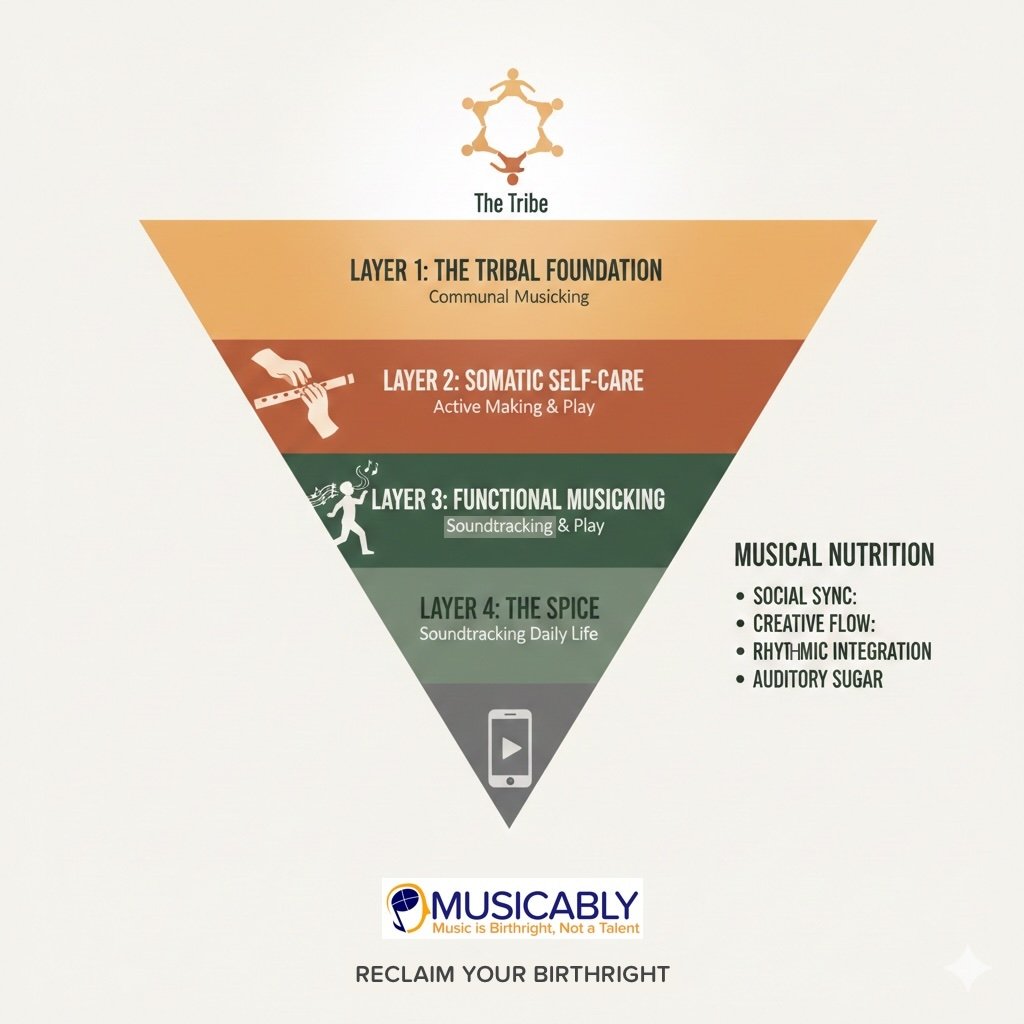
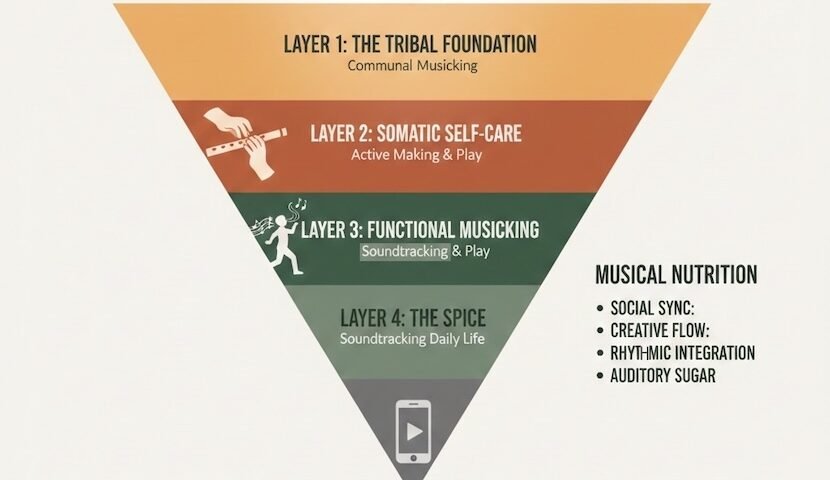
Just as the updated Food Pyramid guides us toward a balanced diet of whole foods for optimal physical health, we need to envision a “Musical Plate” for our sonic wellbeing. That is why I am proposing here an inverted Musicking Pyramid. I will write more about it in my next post.
Over the next few weeks, I’m going to show you exactly how to do that.
We are going to find the “Birthright” in your own biology.
The Great Musical Malnutrition is reversible. It starts with a hum, a tap, a breath – a tiny act of Sonic Sovereignty. It’s about reclaiming your innate human right to make sound, to use music as a tool to self-regulation and joy.
So for now, I have a challenge for you. I want you to find one “processed sound” in your life – maybe a playlist you always put on auto-play – and turn in off for ten minutes. And in that silence, I want you to hum. Anything. A three-note melody. Feel the vibration in your chest.
The vibration is the “Whole Food.” That is the protein.
Stop being a consumer. Start being a maker!
And if you prefer, you can tune in to Episode 1 of the Musicably podcast to listen to more about the science of brain fireworks and how you can begin your journey toward a well-nourished sonic life. Musicably Podcast is also at Apple, Spotify, Amazon, and YouTube.
And remember, at Musicably, there’s no such thing as a wrong note, only unexplored resonance.